This week I've some thoughts on landscape photography in New Zealand and particularly the seasons in Central Otago and Wanaka - my home patch.
The two things that strike me as a committed landscape photographer are the diversity of the seasons, and how it's so easy to go to vastly different environments in and from Central Otago [inc. the Queenstown area], to Fiordland and the South Westland areas - all within just a few hours drive of Wanaka, if not minutes away. Below we'll explore this variety starting with the autumn:
Mt Maude near Wanaka with the mouth of the Cardrona river in the foreground - a relatively low rainfall area free of vegetation so we can see the effects of recent glaciation...
Back in the hills a bit inland from Queenstown at the historic [and very partially restored] ghost town of Macetown, we see a restored bakery. Remember that back in this town's hay-day there would be no trees, and set in the deeply incised hills of the Shotover and Arrow river area, brutally cold in winter, and wickedly hot in summer...
New Zealand being a small island in the huge Southern Ocean means a maritime climate, and this translates in winters that are nearly impossible to forecast. The Snow Farm only 40 mins. drive from Wanaka shows the severity possible as an early winter storm begins to clear...
But some winters a high pressure weather system can sit over the South Island for weeks causing an inversion in many inland valleys and basins, and then we get hoar frost crystals growing on these Cardrona valley trees 20 mins. from Wanaka, and then [sometimes after weeks even], the crystals melt within 20 mins. of the sun breaking through the cloud...
And when the weather does settle in the winter, it becomes a playground rich with possibilities! Again the Snow Farm Nordic Ski Area, with a paraglider using skis to have some fun...
But, while its all snow and fun in the Central Otago ski areas, in Fiordland rain is still the norm., but as there is much less in winter in areas typified by this shot in Doubtful Sound it's the time to be a tourist enjoying the cliffs that rise out of the sea almost vertically. The top layer of the water is actually fresh water and not salt - such is the quantity of rainfall and run-off...
Winters are short though in New Zealand, and before long in about late Sept. streams in the mountains are growing with melt water. The tracks in this photo taken at the head of the Meg river in the Pisa range near Wanaka and Cromwell are made by rabbit like hares...
A couple of eccentric sheep on West Wanaka Station don't know how lucky they are - that grass will be brown in a couple of months when summer replaces spring, and by then they may also be off to "freezing works" to become succulent lamb chops for us, and sheep skin slippers to keep our feet cosy in the next winter...
Spring is also evident here - the Matukituk river [flows from Mt Aspiring to Lake Wanaka] is swollen with "spring melt" and the willows have that translucent vivid green look that is later replaced by a dullness as summer comes on...
The light in mid summer can be so "shimmering" and white like as a result of the dry inland climate. This is the Rob Roy glacier in Mt Aspiring National Park - again within a couple of hours combined drive and walk from Wanaka...
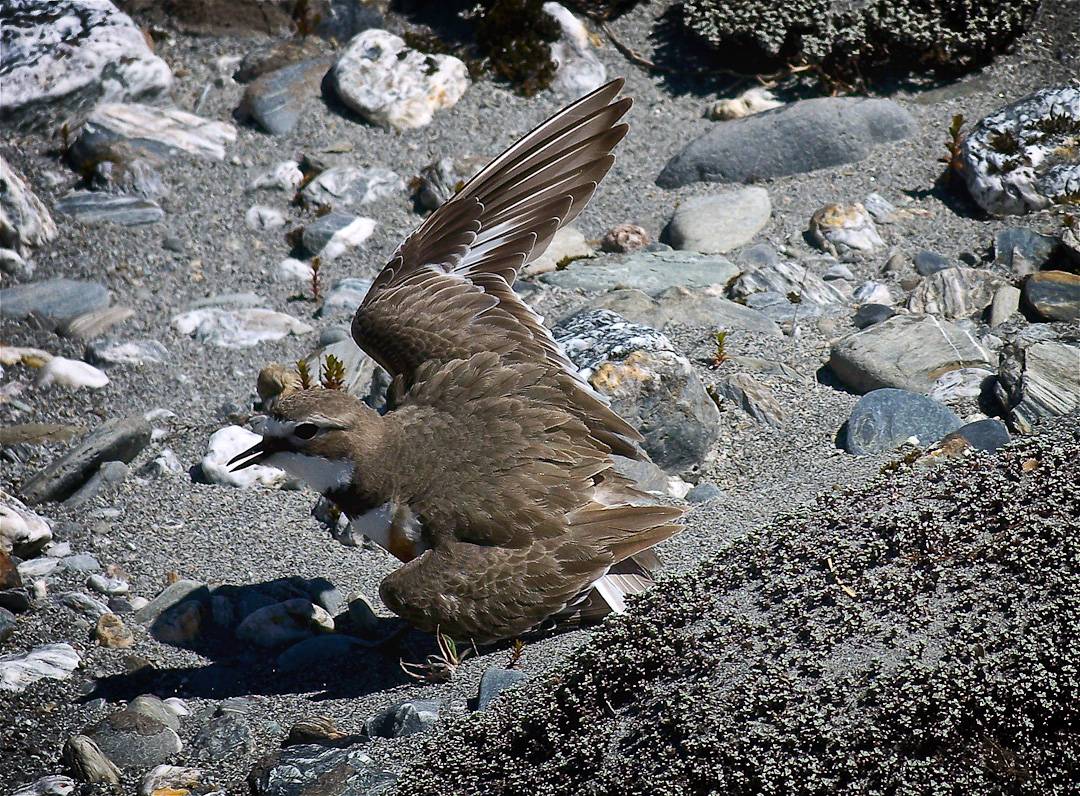
As summer rolls on I like to take an interest in the unique bird life on our braided river beds unique to New Zealand, Alaska and a few other areas [braiding happens when a river carrying vast amounts of eroded sediment slows down in various areas of it's channel - the sediment then "drops out" and is deposited on the bottom causing the the hight to rise until the river "spills" sideways forming a new channel. It is therefore impossible for such a river to ever flow in a straight line! Hence the term braided]. Here we see the endangered [species] banded dotterel mimicking injuries to lure the photographer away from the nest...
Lastly if you really want "diverse" New Zealand has this too. Fiordland and Stewart Island being notable areas, and within these tracts of wilderness , with a flavour of the Sub Antarctic Islands, are areas of great remoteness like Port Pegasus. This photo taken from Magog...
The potential for photography of New Zealand landscapes is unlimited
...more>>